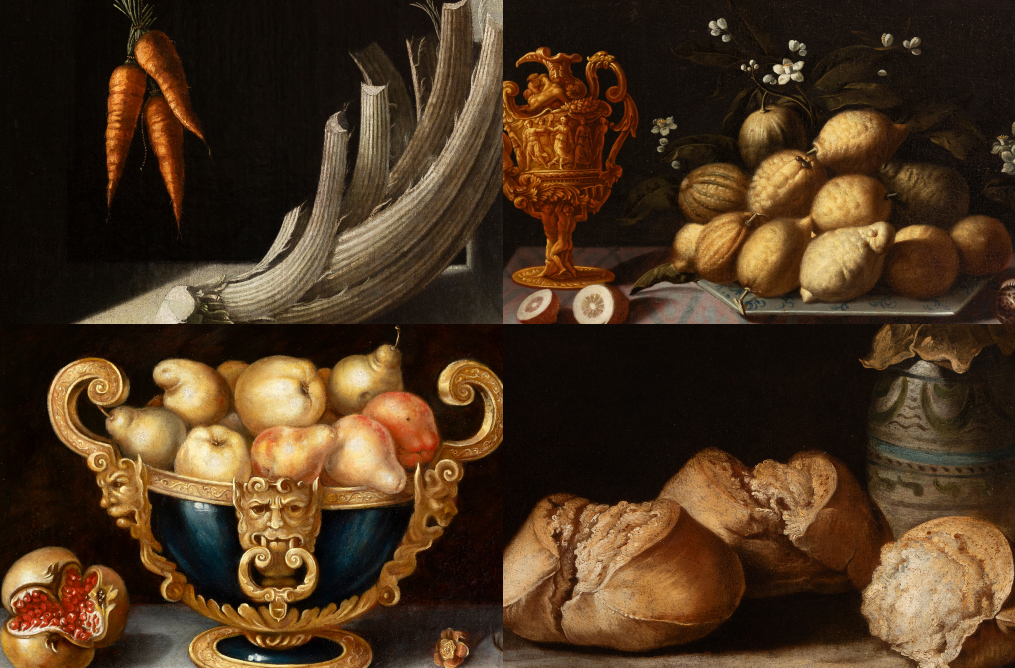
From the austerity of Sánchez Cotán to the refinement of Luis Egidio Meléndez, this selection explores some of the most distinctive chapters in the history of Spanish still life.
There are genres of painting that find their greatness in the depiction of extraordinary events, and others that, on the contrary, discover in everyday life an inexhaustible source of artistic possibilities. The still life belongs to this second category. Fruit, vegetables, containers, flowers, or game become, under the painter’s gaze, the focal points of compositions in which nothing is left to chance.
Although for centuries it was considered a secondary genre compared to religious, mythological, or historical painting, still life developed its own identity in the 17th and 18th centuries. Its development was particularly significant in Spain, where it took on a distinctive character, marked by compositional restraint, naturalistic rigor, and exceptional attention to the material qualities of each individual element.
Setdart’s upcoming “Private Collection” auction brings together a selection of works that offers insight into different periods of this tradition. From Sánchez Cotán to Meléndez, the selection reveals the diversity of artistic styles that made still life one of the fundamental chapters of Spanish painting.
The Origins of the Spanish Still Life: Juan Sánchez Cotán
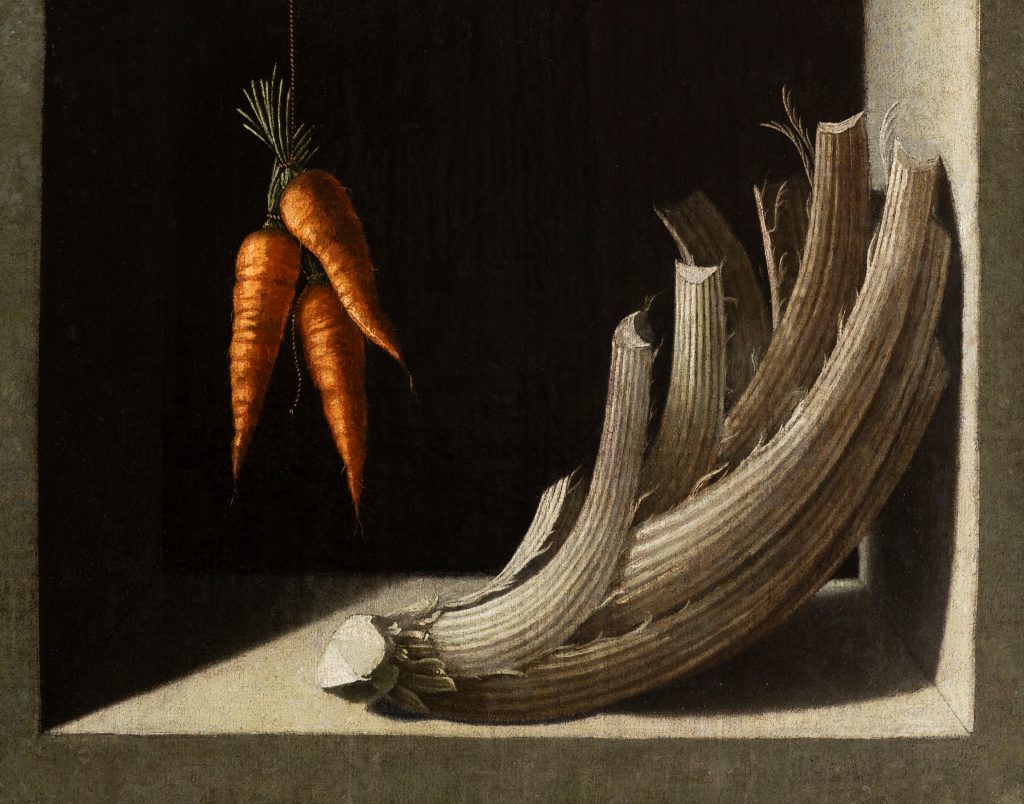
One of the fundamental starting points for understanding this tradition is the figure of Juan Sánchez Cotán (1560–1627). Considered one of the great pioneers of Spanish still life, he developed a style of extraordinary character, based on the reduction of elements, the precision of forms, and an almost architectural conception of space.
His paintings are devoid of any superfluous elements. Objects appear isolated against dark backgrounds, arranged in niches or on stone windowsills, as if each one were demanding individual attention. The carefully directed light defines their volumes and accentuates their physical presence.
This concept finds a particularly interesting expression in the *Still Life with Carrots and Thistle*, featured in the auction and attributed to Sánchez Cotán in the art-historical study accompanying the work. The composition features three carrots suspended by a thin string and a large thistle, their organic forms silhouetted against a black background.
The formal connection to the well-known *Still Life with Thistle* at the Museum of Fine Arts in Granada allows us to place this painting within one of the artist’s most characteristic compositional styles. Beyond its apparent simplicity, the work highlights one of the genre’s greatest achievements: demonstrating that pictorial intensity does not depend on an abundance of elements, but rather on the ability to guide the viewer’s gaze.
The Splendor of the Courtly Still Life: Juan van der Hamen
As the 17th century progressed, the Spanish still life gradually expanded its repertoire. The austerity of the early works gave way to more elaborate compositions, in which food was depicted alongside sumptuous vessels and highly refined decorative elements.
In the Madrid of Philip IV, Juan van der Hamen y León (1596–1631) played a decisive role in this evolution. His painting combines the naturalistic precision of the Spanish tradition with Flemish and Italian influences.
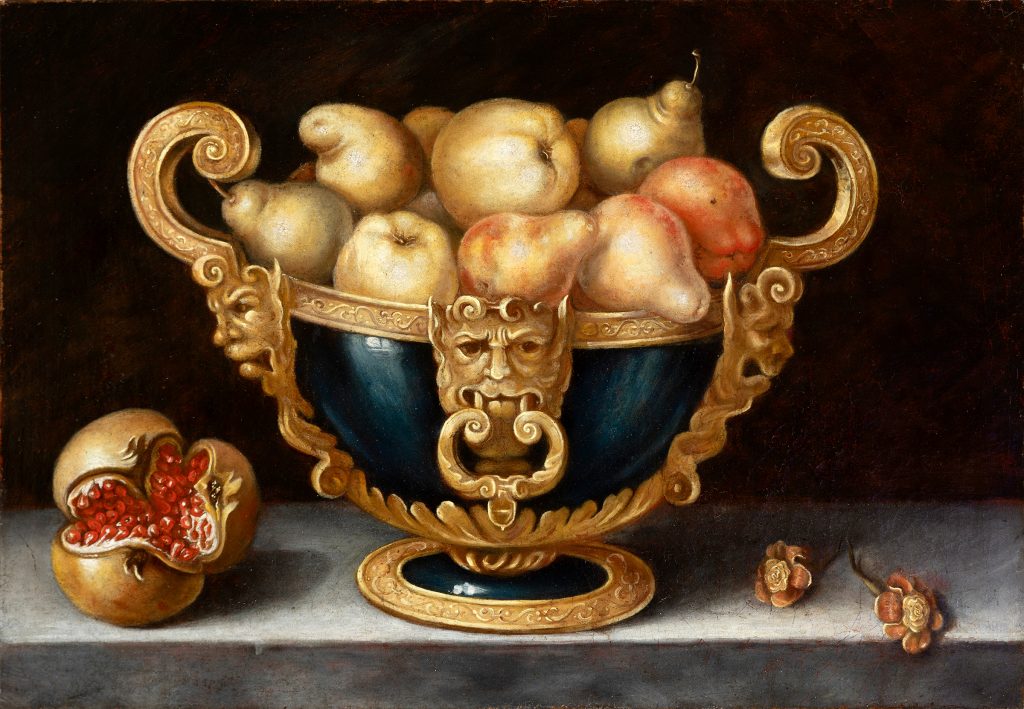
The Large Fruit Bowl with Pears, Pomegranates, and Flowers, created in his studio around 1622–1623, is a significant example of this artistic style. The composition is dominated by an elegant ornamental vessel inspired by Italian Mannerism, from which emerges a carefully arranged display of fruit. On the windowsill, an open pomegranate and some small flowers complete the scene.
The contrast between the decorative richness of the fruit bowl, the luminosity of the fruit, and the depth of the dark background reveals the interest in material qualities that characterizes this school. It is not merely a matter of reproducing food, but of establishing a dialogue between nature and artifice, between the organic irregularity of the fruits and the sophistication of manufactured objects.
Painting also offers insight into the workings of Golden Age workshops and the dissemination of successful models. The demand for these compositions led to the creation of variations and replicas that adapted the master’s most prized designs to different formats and collecting contexts.
The Valencian School and the Virtuosity of Tomás Hiepes
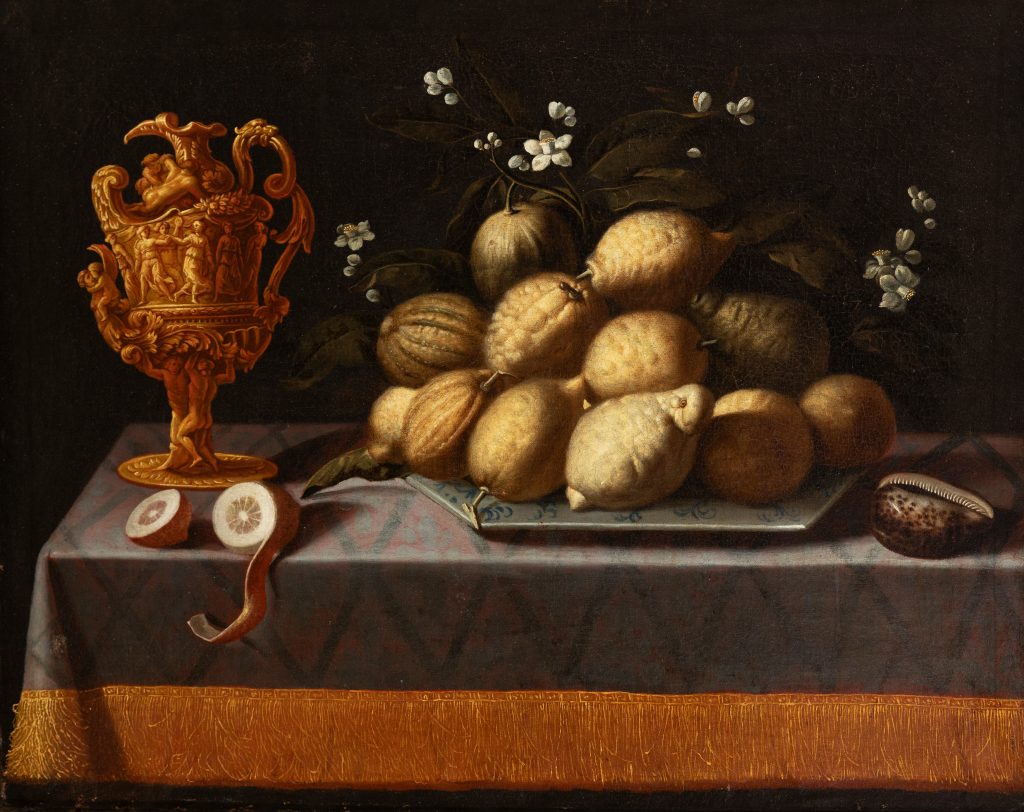
Another major center of Spanish still-life painting developed in Valencia, where Tomás Hiepes (c. 1600–1674) achieved notable recognition for his still lifes and flower arrangements.
His painting is distinguished by its rigorous composition, striking descriptive clarity, and a constant interest in the specific characteristics of each material.
The Still Life with a Golden Jug, Citrus Fruits, and a Seashell is a particularly appealing example of this repertoire. The composition features a series of citrons arranged on a ceramic platter, a sumptuous golden jug, and a seashell that adds an exotic touch to the ensemble.
The diversity of materials offers the painter an extraordinary field for experimentation: the rough surface of the fruit, the sheen of the metal, the delicacy of the fabric, and the pearlescent quality of the shell all call for distinct painterly approaches. Added to this is the treatment of the jug, whose ornamental repertoire includes references to the Mannerist tradition and to decorative motifs disseminated through engraving.
In this work, the still life takes on a particularly sophisticated dimension. The objects are not only presented as subjects for observation, but also reveal the tastes of a society that found in natural products and the sumptuary arts an expression of distinction and refinement.
Francisco Barrera: Abundance, Composition, and Naturalism
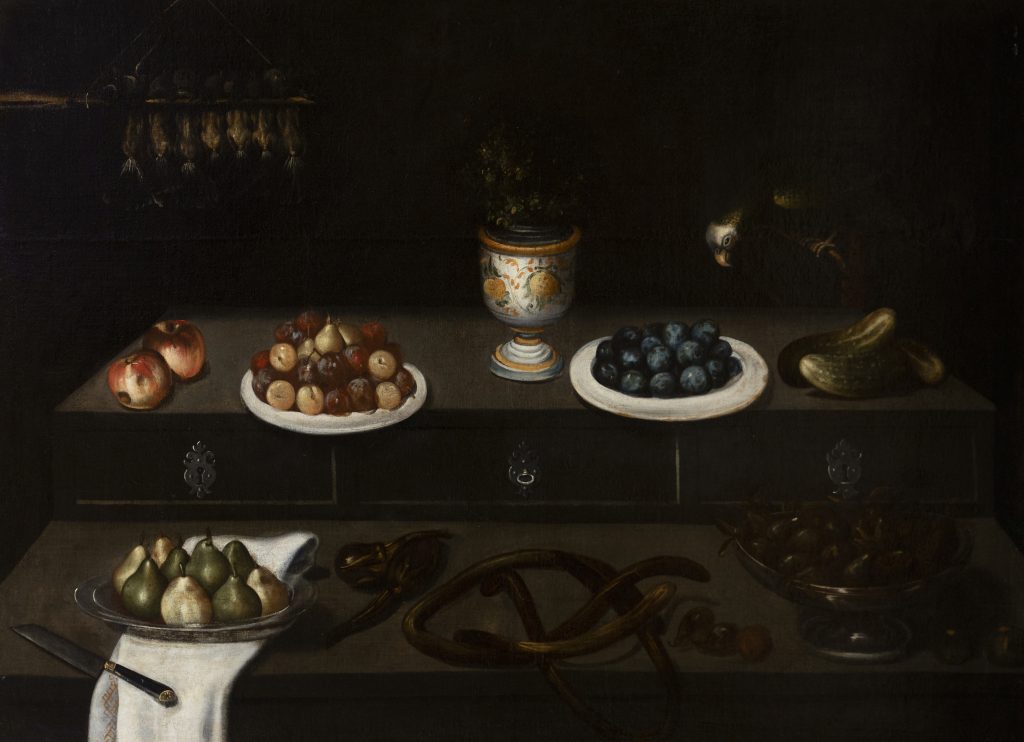
The 17th-century Madrid tradition finds another expression in Francisco Barrera (1595–1658), whose work is characterized by broader compositions and a less rigid arrangement of elements than that of the early still-life painters.
His *Still Life with a Turtle Dove* illustrates this evolution. In contrast to Sánchez Cotán’s concentration of motifs or Van der Hamen’s almost architectural arrangement, Barrera presents a more expansive scene, in which fruits, vegetables, containers, and game are arranged on a dark piece of furniture.
The objects overlap, appear at different heights, and establish spatial relationships that lend depth and dynamism to the composition. The lighting draws attention to the food and the ceramic pieces, while the dimness in the background evokes the cozy atmosphere of a pantry.
The presence of the turtle dove also introduces a dimension linked to the tradition of hunting still lifes, in which the depiction of nature’s bounty could be associated with both abundance and the transience of life. The result is a composition of great visual richness that reflects the diversity achieved by the Madrid school during the Baroque period.
Luis Egidio Meléndez: Still Life in the 18th Century
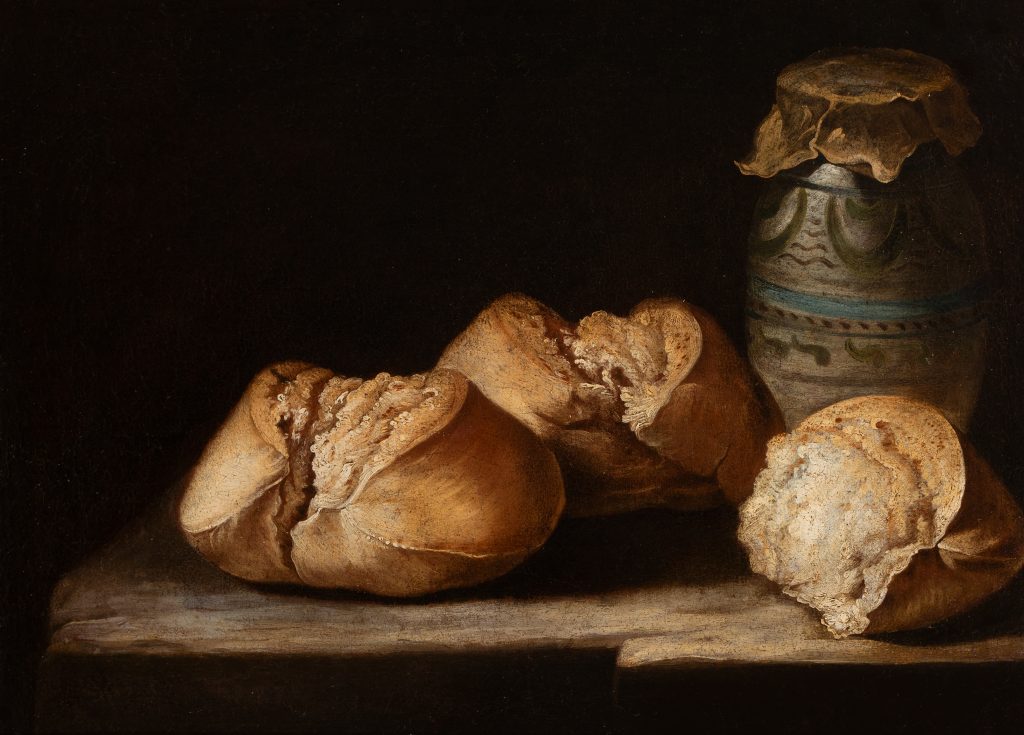
This artistic tradition reached one of its most refined expressions in the 18th century with Luis Egidio Meléndez (1716–1780), considered one of the great masters of European still life of his time.
His work represents one of the pinnacles of Spanish naturalism. His extraordinary attention to textures, the solidity of the forms, and his mastery of lighting transform everyday objects into true exercises in painterly virtuosity.
*Still Life with Honey Pot and Bread* is a representative example of this artistic sensibility. The composition features several loaves of bread with open crusts and a ceramic honey pot partially covered by a cloth. The light, coming from the side, reveals the irregularities of the loaves and the nuances of the ceramic surface.
Meléndez’s interest in household utensils and the depiction of natural products reached an exceptional level with the commission for forty-four still lifes intended for the Natural History Cabinet of the Royal Palace, created for the Prince and Princess of Asturias, the future Charles IV and Maria Luisa of Parma.
This project, developed during the 1760s and 1770s, reflects the Enlightenment spirit of the era, in which the meticulous observation of nature was also a form of knowledge. In his compositions, descriptive precision is not at odds with artistic sensibility: every food item, container, or utensil takes on an almost tangible presence.
A tradition that transcends the everyday
Viewing these works together allows us to understand just how much the still life was far more than an exercise in naturalistic representation. Throughout the 17th and 18th centuries, the genre developed its own language, capable of incorporating various influences, responding to changing tastes, and exploring the expressive possibilities of painting through the objects closest to us.
Sánchez Cotán’s austerity, Van der Hamen’s courtly refinement, Hiepes’s material precision, Barrera’s compositional breadth, and Meléndez’s virtuosity represent different responses to the same question: how to transform visible reality into a pictorial experience.
It is precisely in this capacity that the enduring relevance of still life lies. In these compositions, the everyday ceases to be ordinary and becomes a subject of contemplation. A piece of fruit, a ceramic object, or a simple slice of bread can reveal, through the artist’s eyes, the full complexity of light, form, and time.
The selection featured in Setdart’s upcoming “Private Collection” auction thus offers an opportunity to explore some of the key figures and artistic languages of a tradition that holds a central place in the history of Spanish painting.