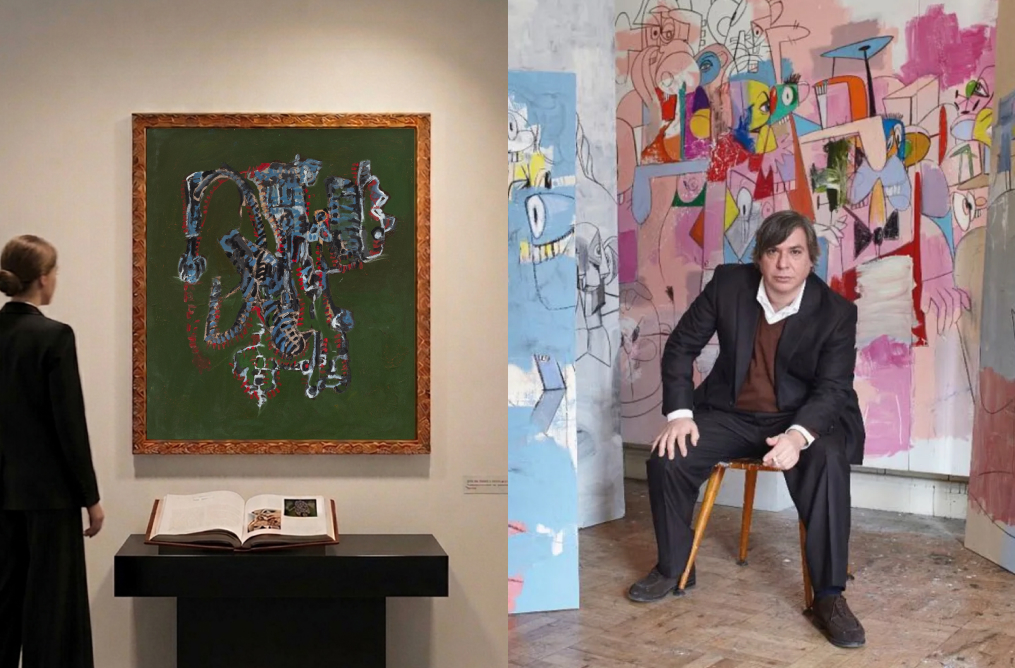
If we had to name a contemporary artist who has managed to dismantle the solemnity of classical European painting and reassemble it through the lens of a psychotic and visceral comic book aesthetic, that artist would undoubtedly be George Condo. Since his emergence on the vibrant and chaotic New York scene of the early 1980s, this artist has charted a unique course, firmly maintaining his position on a blurred frontier where reverential respect for the great masters of art history merges with absolute and savage irreverence. Understanding George Condo’s current impact requires a retrospective look at his formative years, a journey through time that finds invaluable testimony in the 1983 canvas, in which the artist condenses the initial explosion of his highly personal visual universe.
George Condo and the Melting Pot of the 1980s: From New York to the European Tradition
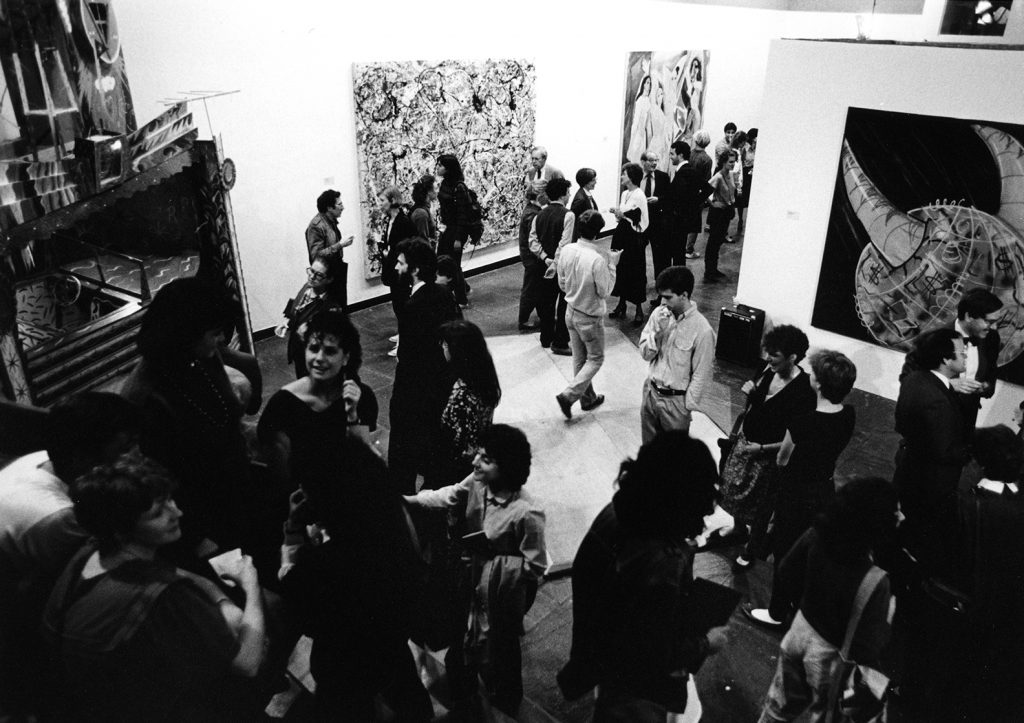
George Condo’s arrival in New York City coincided with a period of cultural effervescence unlike anything seen before. The East Village had rapidly become the epicenter of an underground artistic revolution where artists of the caliber of Jean-Michel Basquiat and Keith Haring were embracing street iconography and graffiti techniques to challenge the clean, cold minimalism that had prevailed in previous decades.
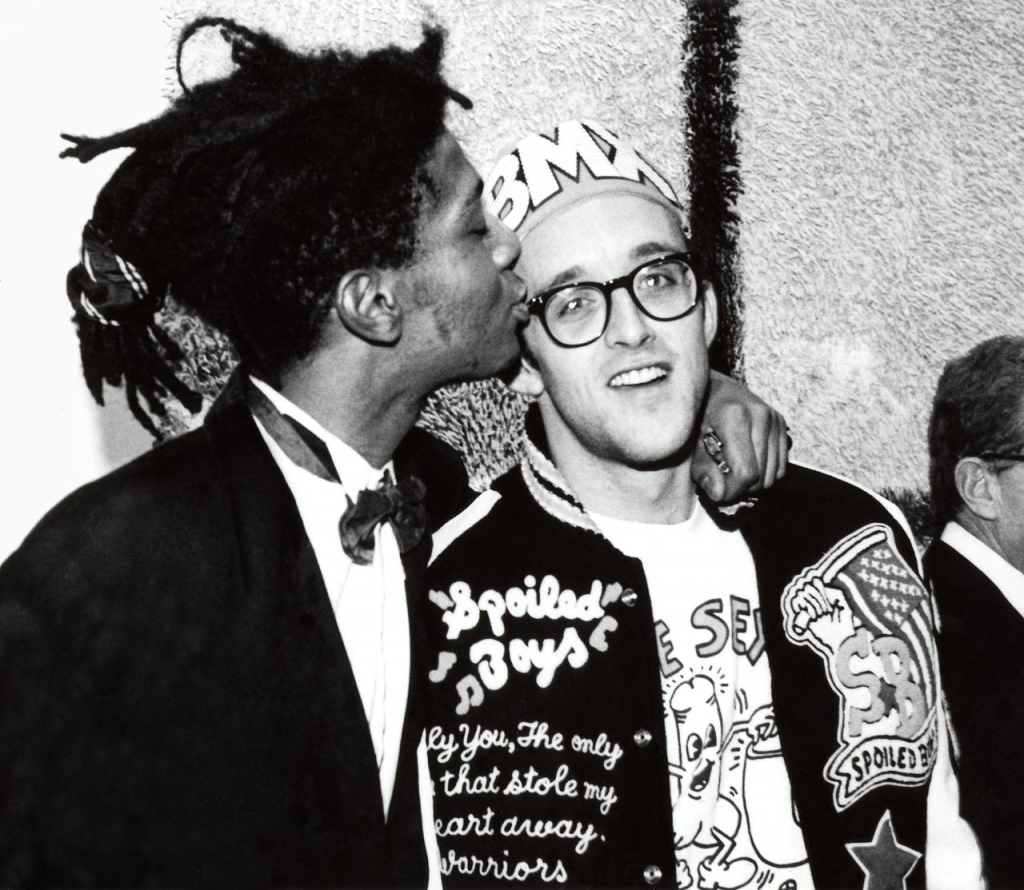
However, while the vast majority of his contemporaries turned their gaze toward the crumbling walls of the city, Condo chose instead to fix his eyes on the collections of European museums, viewing them through a deeply distorted lens. His genius lay precisely in fusing the purely visceral freedom of American Abstract Expressionism—drawing very directly on the gestural violence of Willem de Kooning—with the psychic automatism derived from Surrealism and the geometric and emotional deconstruction proposed by Pablo Picasso.
George Condo and the Development of Artificial Psychology
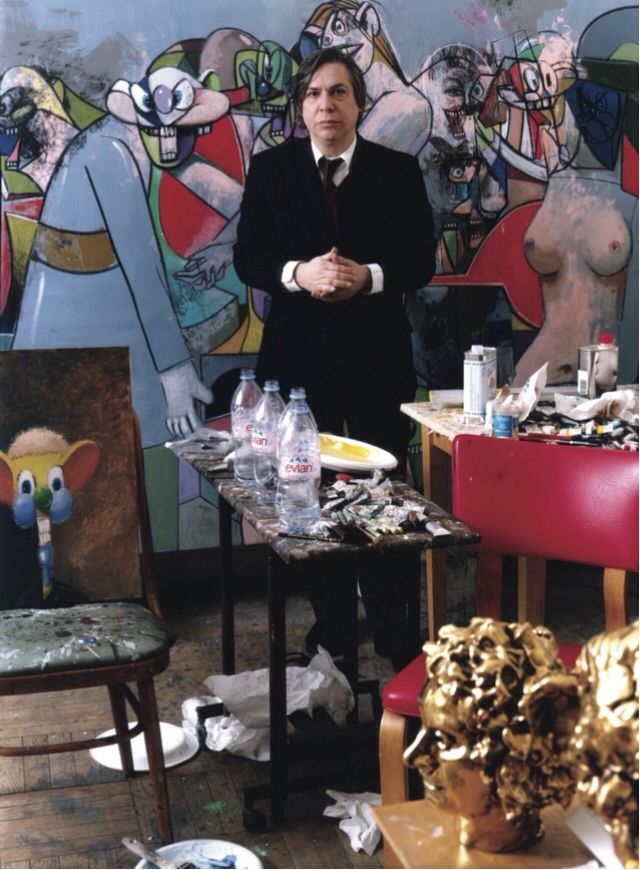
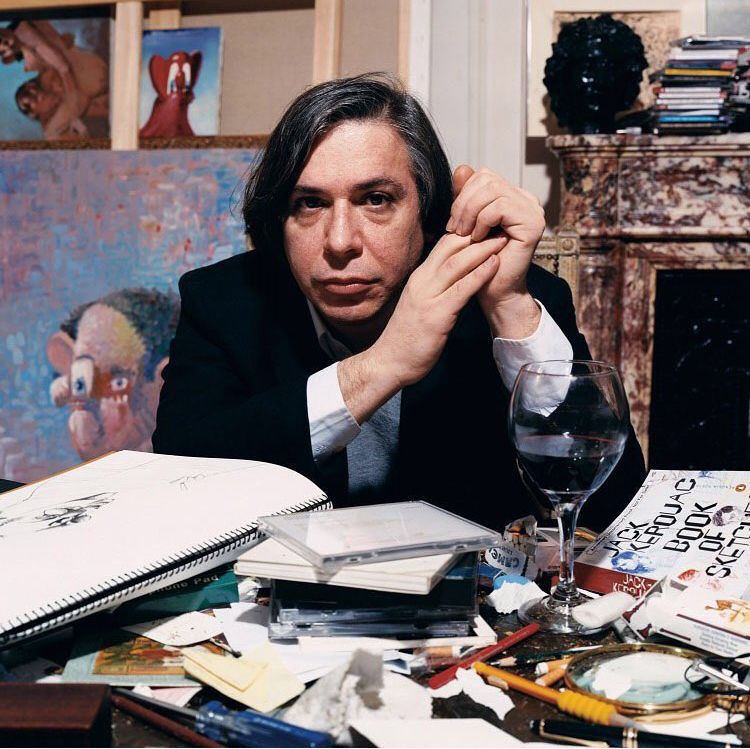
Over the course of decades, this unique blend of conceptual and technical influences crystallized into the fundamental concepts that today define the entirety of his mature body of work, formally known as Artificial Realism and Artificial Psychology. Through these theoretical notions, George Condo does not seek to portray real-life figures or capture specific identities, but rather to bring to life fictional entities and delirious archetypes that, despite their obvious anatomical deformities and histrionic features, reflect with truly surgical precision the mental disorder, deep anxiety, and perennial comedy of the modern human condition.
The painting in question is an outstanding example of this conceptual laboratory in its earliest and purest phase, faithfully documenting the precise moment in time when George Condo began to formulate the guidelines for his own pictorial approach.
Anatomy of Chaos: An Analysis of the Work
Upon closer inspection of the canvas’s surface, the composition immediately draws us in with a complex central figure that seems to be in a constant struggle between structural order and absolute chaos. The artist articulates this motif through a dense and variegated accumulation of organic and mechanical forms that convey the powerful impression of simultaneously assembling and disintegrating before the viewer’s eyes.
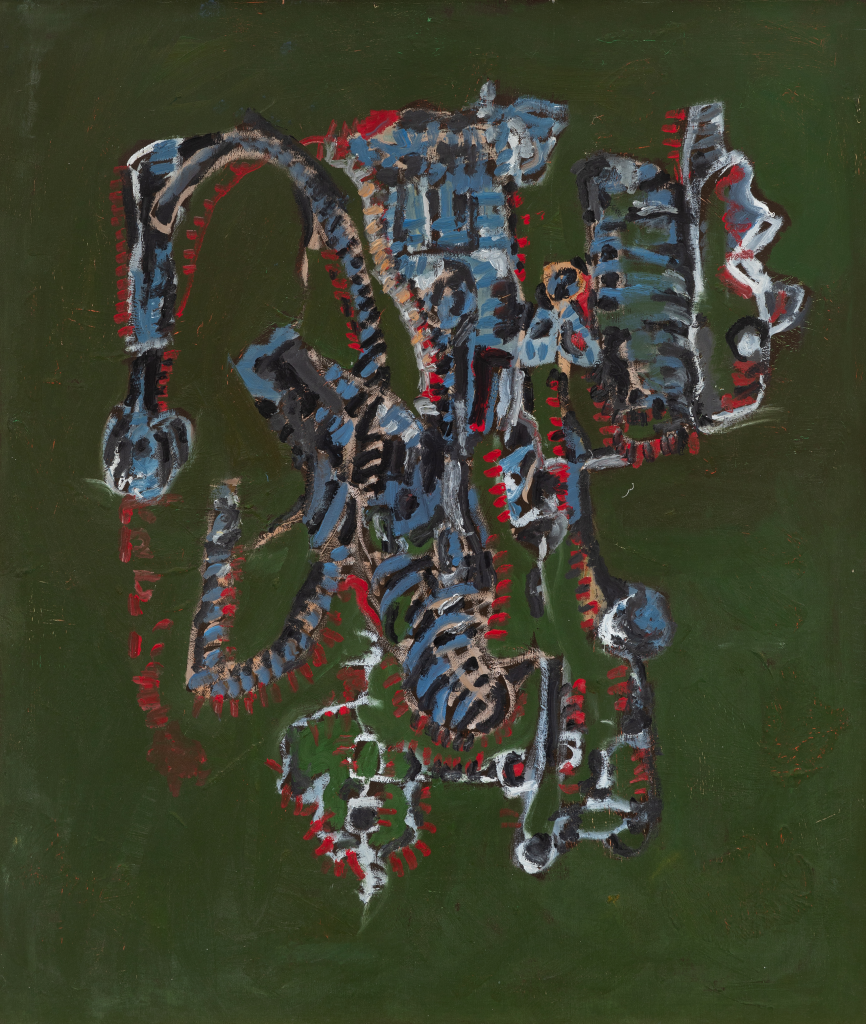
The body of this unnameable creature appears before us as a mutated and fragmented entity, meticulously defined by a frenetic dynamism composed of nervous lines, markedly accelerated gestural rhythms, and extreme chromatic tensions. Against a dense, opaque dark green background—which inevitably evokes a nocturnal atmosphere or a deep mental space—George Condo introduces subtle yet vibrant accents of red that dot the composition.
These strategic touches of warm pigment not only dramatically break up the monochromatic quality of the setting, but also exponentially intensify the sense of pent-up energy, giving the image a deeply ambiguous character that masterfully oscillates between the purely comical and the unsettling.
To analyze this early oil painting is, in short, to gain direct insight into the genetic and structural blueprint of an artist who would completely redefine the boundaries of 21st-century figurative painting. Far from settling for mere scholarly references or superficial pastiches of his illustrious European predecessors, the young George Condo demonstrated in this work a truly astonishing conceptual maturity, managing to transform the historical lessons of the Western tradition into intricate structures of profound visual psychology.
We are thus presented with a living testament to the birth of a titan of contemporary art, a completely indispensable piece for rigorously understanding how those early nervous lines, floating masses, and mutating forms ultimately and definitively conquered the galleries of the most prestigious museums on the planet, establishing their creator as the indispensable visual chronicler of our own collective cultural schizophrenia.
Why is this a must-have piece by George Condo?
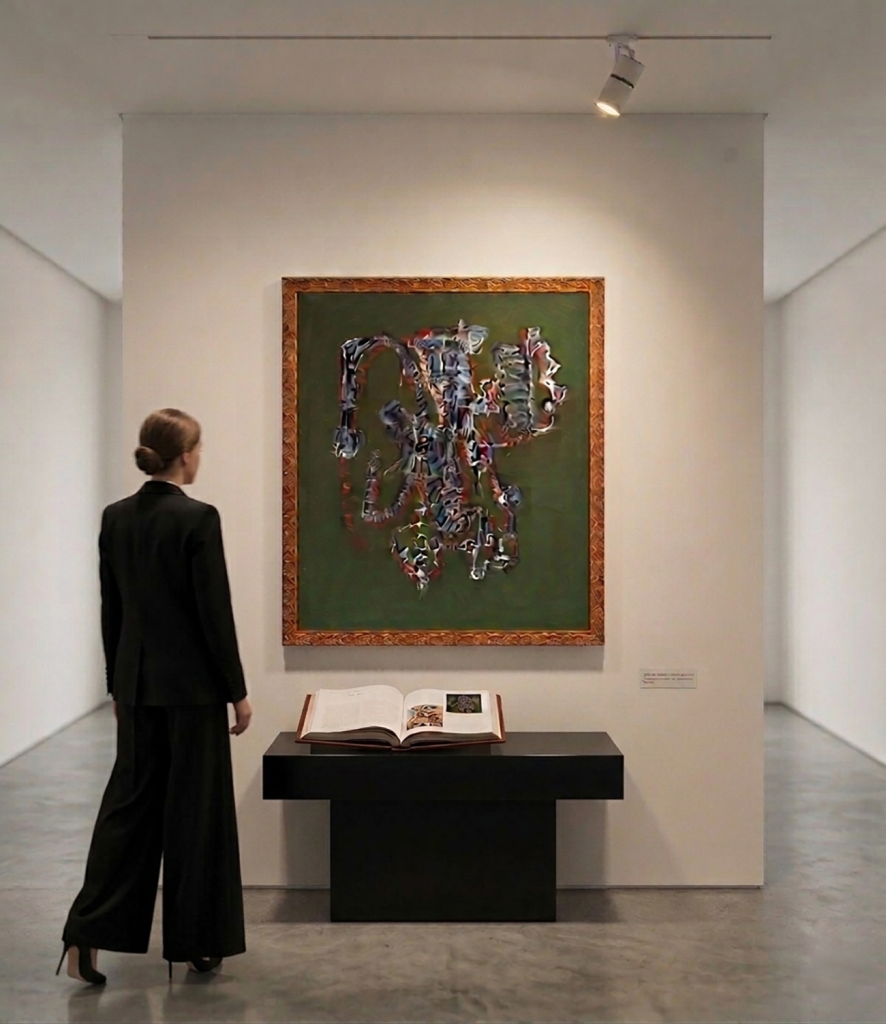
Looking at this 1983 oil painting is like reading the opening pages of a great novel. In the energetic, almost visceral brushstrokes, one can already glimpse the mature George Condo who, years later, would break records at auctions around the world and have his paintings hung at MoMA or the Tate Modern. It is a road map of his mind: the precise moment when traditional figuration breaks down to make way for the wonderful and fascinating schizophrenia of contemporary art.
One final detail for collectors: the presence of the Pat Hearn Gallery label on the back serves as a mark of historical authenticity. Pat Hearn was one of the leading figures in New York’s alternative art scene of the 1980s; the fact that this work passed through his hands and then through an institution like the Queensborough Community College Art Gallery confirms its significance during George Condo’s formative years.
We invite you to explore our Contemporary Art and Latest Trends auction, where you’ll find works by George Condo alongside key figures on the international art scene such as Bernard Buffet, David Hockney, Damien Hirst, Yves Klein, Antonio Saura, El Lissitzky, Bernar Venet, Antoni Tàpies, and many more.
If you liked this article, you may also be interested in:
- De Kooning and the legacy of Abstract Expressionism
- Abstraction and figuration: two paths that continue to intersect