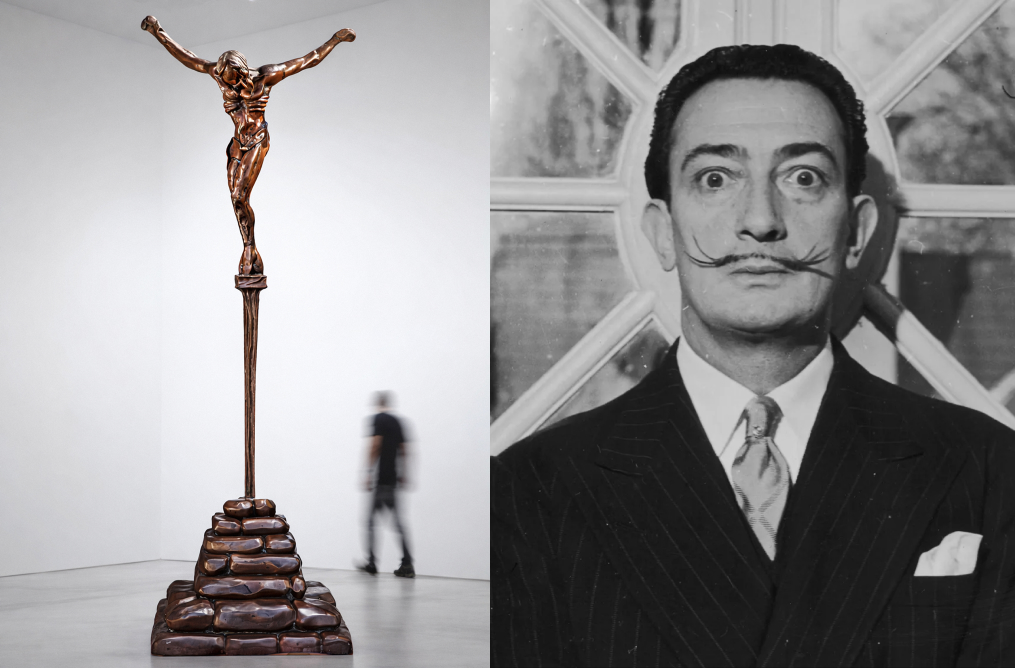
What do we really see when we look at Salvador Dalí’s iconic Christ of St. John of the Cross – a traditional religious image or a deeper reflection on infinity and the nature of the absolute?
What Dalí proposes is not a conventional representation of the Crucifixion, but a radical reinterpretation of one of the most universal symbols of Christianity.
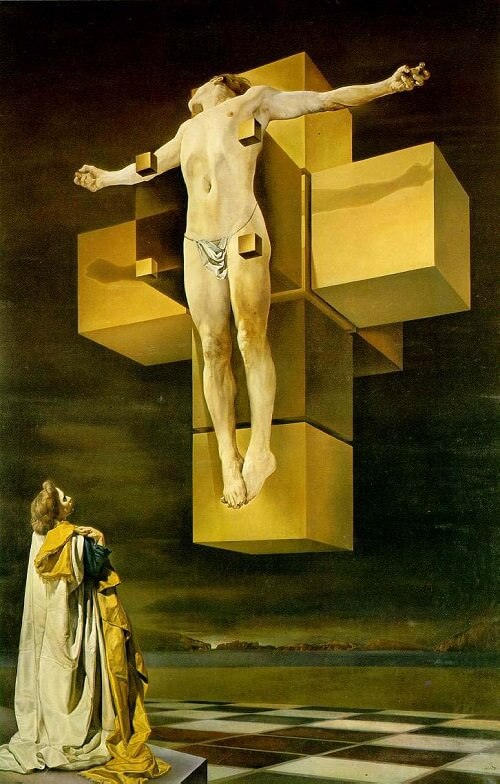
Inspired by the mystical drawing attributed to St. John of the Cross, the artist transforms the scene into a suspended vision, silent and alien to the usual iconographic tradition. Here, the Christ of St. John of the Cross does not suffer dramatically nor is he subjected to gravity: his body floats, intact, in a dark space that seems to extend beyond the physical.
A break with iconographic tradition: an image born of mysticism, not pain.
The root of this work is not in suffering, but in contemplation. Dalí starts from the mystical experience associated with St. John of the Cross, where the idea of spiritual ascension and union with the divine replaces any narrative or historical reading of the episode.
In contrast to the Spanish baroque tradition, which insisted on the dramatism of pain, Dalí eliminates all accessory elements: there is no blood, no torn gestures, no spectators. The scene is reduced to the essential, and in this purification a completely new image of the Crucifixion emerges. In the Christ of St. John of the Cross, what is relevant is not the sacrifice itself, but its suspension on a higher plane of existence.
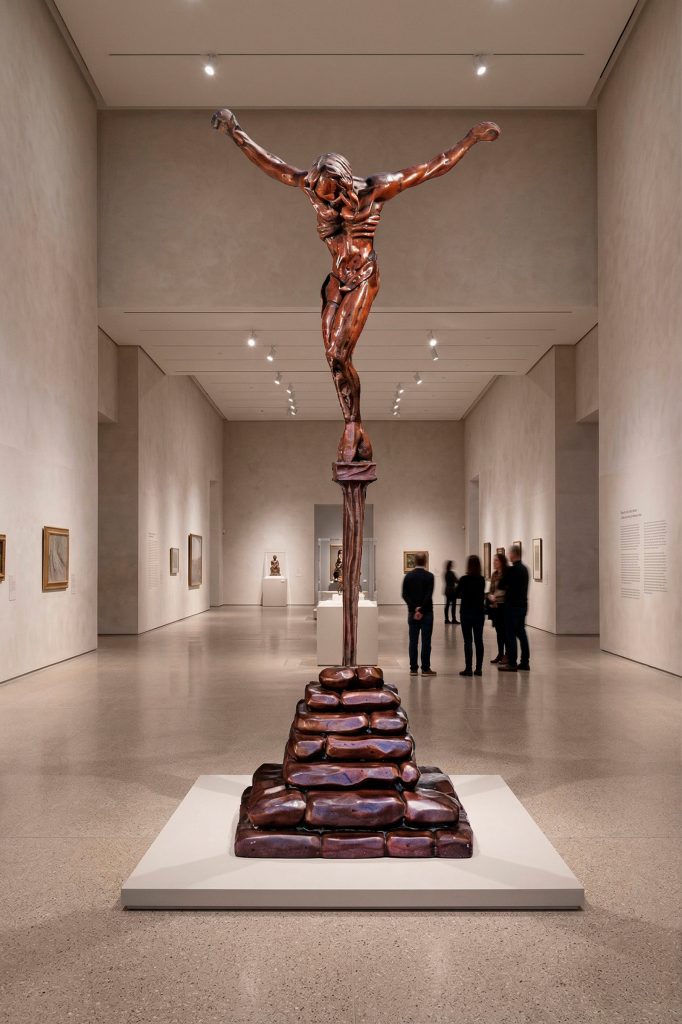
The elevated point of view, almost impossible, places the viewer in a position close to the divine. We no longer contemplate the scene from the ground, but from a transcendent plane. This completely transforms the experience: the Crucifixion ceases to be a historical event and becomes a visual structure suspended in the void.
In this context, the Christ of St. John of the Cross transcends its religious reading to become a true iconography of the absolute. The cross ceases to be an instrument of suffering to become a cosmic axis; the body of Christ ceases to be flesh to become a suspended form; and space no longer acts as a background, but as an infinite void, almost metaphysical in nature. Dalí does not represent an episode, but an idea: the possibility that the sacred belongs to a dimension where matter, time and pain lose their usual meaning.
Influences: from Spanish mysticism to modern physics
The complexity of the Christ of St. John of the Cross can be understood from the multiple influences that converge in Dalí’s thought at this time.
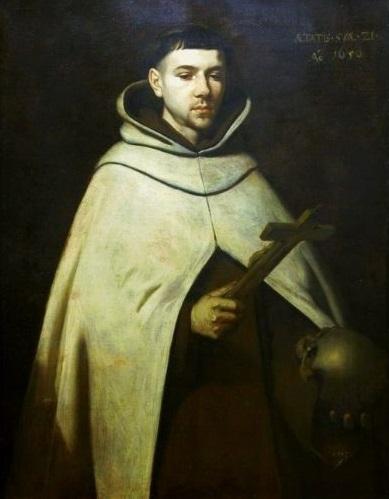
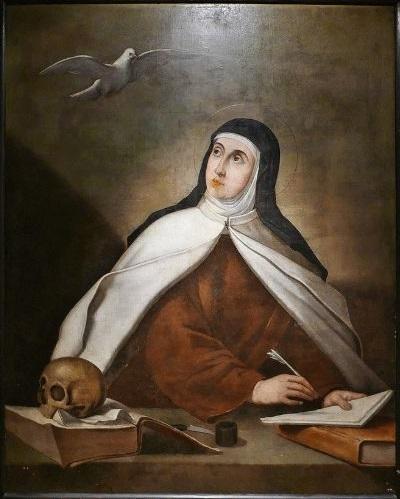
On the one hand, Spanish mysticism – St. John of the Cross and St. Teresa of Jesus – contributes the notion of union with the absolute and the overcoming of the material. This spiritual background is key to understanding the sensation of elevation, silence and suspension that the Christ of St. John of the Cross transmits.
On the other hand, the classical pictorial tradition, from the Renaissance to the Baroque, provides a solid technical base, although reinterpreted from a fully modern point of view.
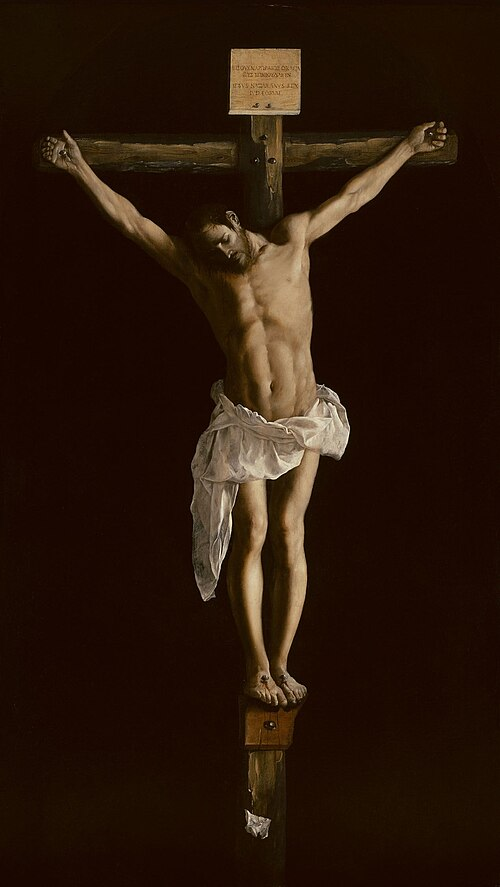
Added to this is the impact of twentieth-century physics. After the atomic era, Dalí conceived matter as something unstable, almost illusory. The suspended body of Christ responds precisely to this new conception of a universe where solidity is no longer a certainty.
Finally, the legacy of surrealism and psychoanalysis is still present, although transformed. If in his previous stage the oneiric and the irrational dominated, now it is oriented towards a more structured construction of images capable of giving shape to metaphysical concepts.
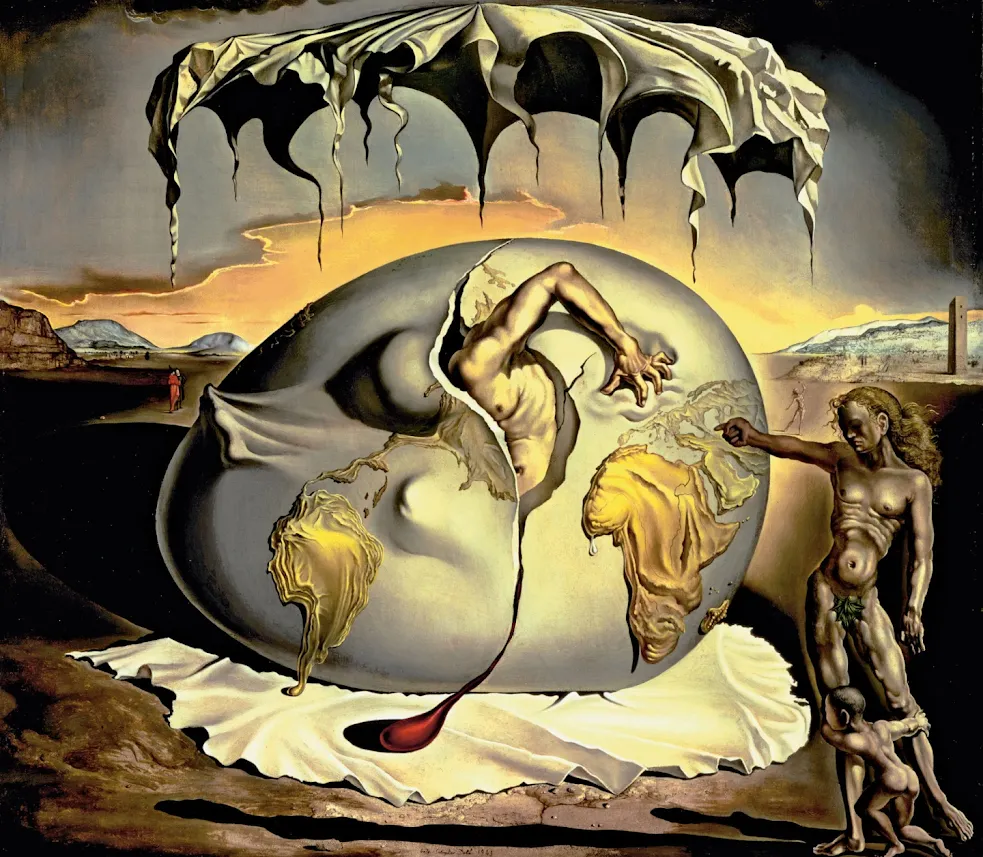
The Christ of St. John of the Cross: A key work in Dalí’s evolution
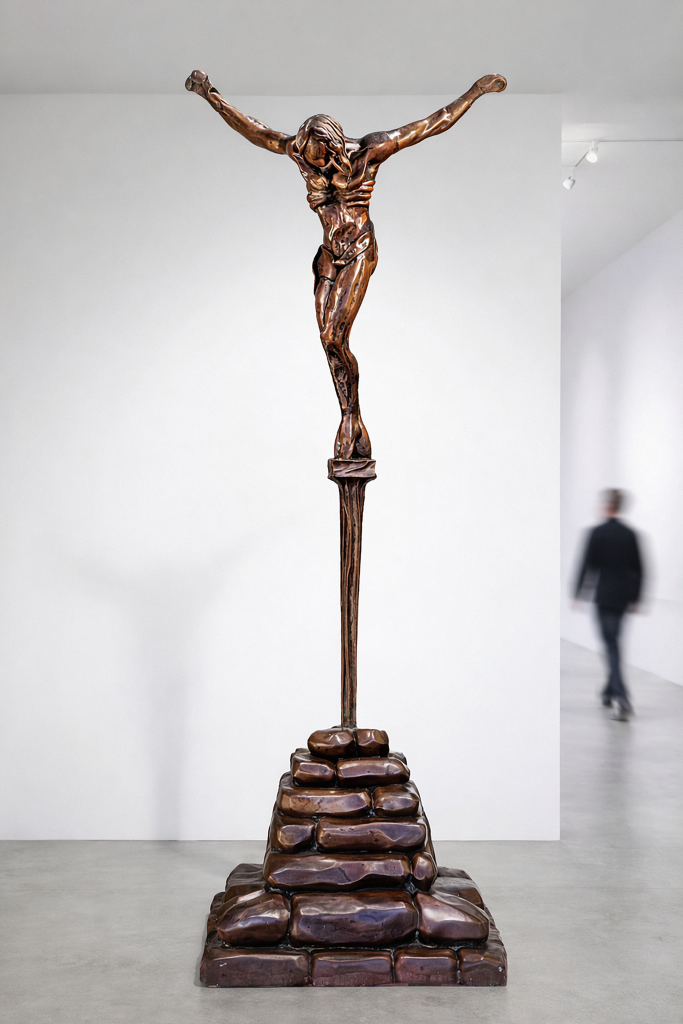
Christ of St. John of the Cross marks a turning point in Dalí’s career. After his most radical surrealist period, the artist began a search for order, spirituality and knowledge that he himself called “nuclear mysticism”.
In this period, Dalí tries to reconcile science, religion and art in the same visual system. It is no longer only a matter of provoking or exploring the unconscious, but of constructing an image of the world that integrates the spiritual and the scientific. The Christ of St. John of the Cross is one of the clearest syntheses of this project: an image that belongs as much to religion as to philosophy and physics.
Today, the Christ of St. John of the Cross transcends the field of religious art to become one of the great images of the 20th century. Its importance goes beyond the museum or the collectible, since it condenses in a single vision mysticism, pictorial tradition, scientific revolution and surrealist imagination.
Do you own works by Salvador Dalí or another contemporary artist and are you considering selling them? At Setdart, you can request a free and confidential valuation, and our team of Contemporary Art specialists will be happy to assist you.
If you liked this article you may also be interested in: